Intel TBB malloc 内存分配器
1. TBB Malloc 介绍
1.1. TBB Malloc 使用入门
有两种方式使用TBB Malloc:Run-Time替换,Link-Time替换。替换的函数(routines)包括:
| routines | Linux | MacOS | Windows |
|---|---|---|---|
| global C++ new / delete | √ | √ | √ |
| C库:malloc / calloc / realloc / free | √ | √ | √ |
| C库(C11):aligned_alloc | √ | - | - |
| POSIX:posix_memalign | √ | √ | - |
Run-Time替换方法:
| 平台 | 替换方法 |
|---|---|
| Linux | export LD_PRELOAD=$TBBROOT/lib/intel64/gcc4.8/libtbbmalloc_proxy.so.2 |
| MacOS | export DYLD_INSERT_LIBRARIES=$TBBROOT/lib/intel64/gcc4.8/libtbbmalloc_proxy.dylib |
Link-Time替换方法:
| 平台 | 替换方法 |
|---|---|
| Linux & MacOS | -L$TBBROOT/lib/intel64/gcc4.8 -ltbbmalloc_proxy |
| Windows | tbbmalloc_proxy.lib /INCLUDE:"__TBB_malloc_proxy" |
Link-Time替换,需要添加编译flags。不添加这些编译flags,可能导致malloc等这些函数被内联为汇编,即失去了符号,也就没有办法替换了。需要添加的flags如下:
Linux/MacOS平台下,添加如下编译flags(适用于Linux/MacOS):
-fno-builtin-malloc
-fno-builtin-calloc
-fno-builtin-realloc
-fno-builtin-free
Windows平台下,icc编译器添加如下编译flags:
- /Qfno-builtin-malloc
- /Qfno-builtin-calloc
- /Qfno-builtin-realloc
- /Qfno-builtin-free
替换Proxy入口代码文件为
src/tbbmalloc_proxy/proxy.cpp。
1.1.1. 直接使用TBB malloc(Compile-Time)
| Allocation Routine | Deallocation Routine | 对应系统运行时库 |
|---|---|---|
| scalable_malloc, scalable_calloc, scalable_realloc | scalable_free | C Standard library |
| scalable_aligned_malloc, scalable_aligned_realloc | scalable_aligned_free | Microsoft C runtime |
与C++ STL对应的allocator:
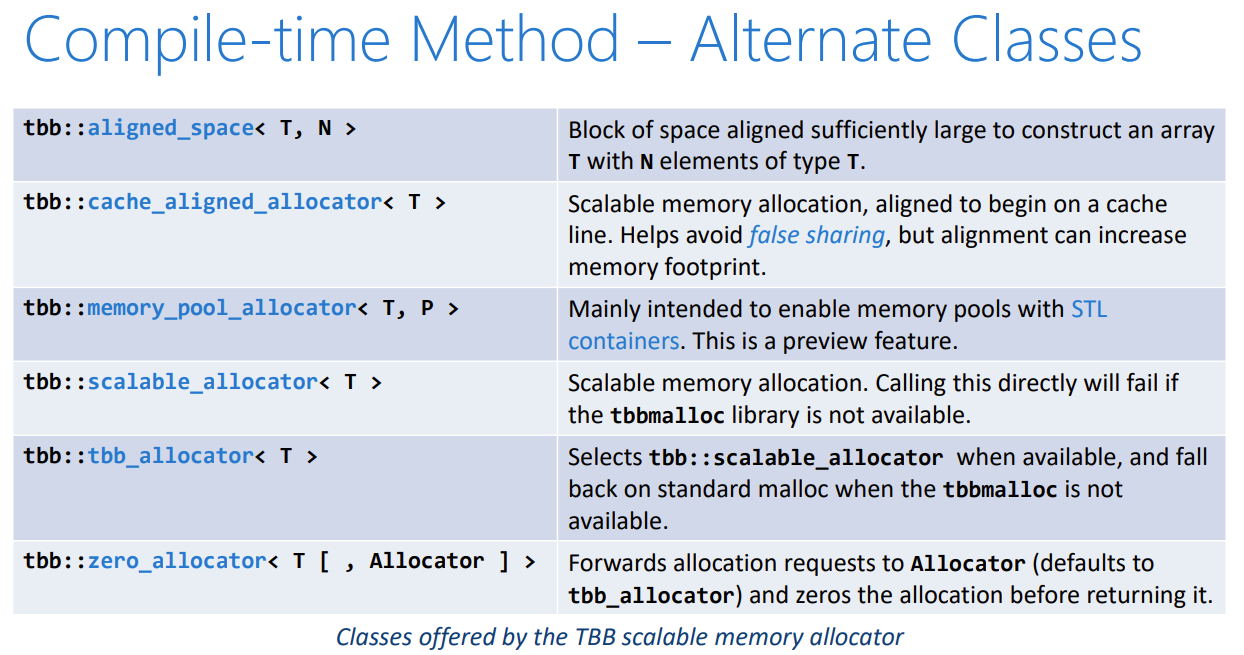
一个简单使用示例:
#include <vector>
#include <algorithm>
#include <execution>
#include <tbb/scalable_allocator.h>

std::vector<int, tbb::scalable_allocator<int>> v{…};
std::sort(std::execution::par, v.begin(), v.end());
1.1.2. Huge Pages
TBB malloc支持Huge Pages,可以通过设置环境变量TBB_MALLOC_USE_HUGE_PAGES来启用,或者在代码中设置:
scalable_allocation_mode( TBBMALLOC_USE_HUGE_PAGES,1);
Huage Pages可以减少malloc调用,减少TLB Miss,提高性能,尤其是在分配大块内存时。
1.1.3. memory_pool_allocator
TBB malloc提供了一个memory_pool_allocator,它通过预先分配一大块内存,避免TBB Malloc模块的管理开销。管理器需要查找空闲块、分割块、记录元数据(这块内存多大、是否在用等)。
其约束为,每次分配的大小为固定的P,因为它是通过简单的基于 P 取模的偏移量获取内存块的。适用于作为STL容器的分配器。一个示例如下:
#define TBB_PREVIEW_MEMORY_POOL 1
#include "oneapi/tbb/memory_pool.h"
#include <list>

int main() {
    oneapi::tbb::memory_pool<std::allocator<int>> my_pool;

    typedef oneapi::tbb::memory_pool_allocator<int> pool_allocator_t;
    std::list<int, pool_allocator_t> my_list(pool_allocator_t{my_pool});

    my_list.emplace_back(1);
}
当memory_pool中内存用尽之后,将向底层Alloc申请内存进行扩容。新增的内存切分成若干FreeBlock,并添加到pool内部的空闲链表。扩容大小由extMemPool->granularity决定,扩容的内存可能来自其他线程丢弃的的orphaned blocks,也可能来自底层Alloc分配的内存。其类声明如下:
//! Thread-safe growable pool allocator for variable-size requests
template <typename Alloc>
class memory_pool : public pool_base
另外,定义了一个fixed_pool,内存池耗尽之后不会扩展。
1.1.4. 局部替代 new & delete
当某些模块需要自定义allocator时,可以通过局部替代new和delete来实现:
#include <tbb/parallel_for.h>
#include <tbb/tbb_allocator.h>

// No retry loop because we assume that
// scalable_malloc does all it takes to allocate the memory,
// so calling it repeatedly will not improve the situation at all

// No use of std::new handler because it cannot bedone in portable and
// thread-safe way We throw std::bad alloc() when scalable mallocreturns NULL
// (we return NULL if it is a no-throw implementation)

void *operator new(size_t size) throw(std::bad_alloc) {
  if (size == 0) size = 1;
  if (void *ptr = scalable_malloc(size))
    return ptr;
  throw std::bad_alloc();
}

void *operator new[](size_t size) throw(std::bad_alloc) {
  return operator new(size);
}

void *operator new(size_t size, const std::nothrow_t &) throw {
  if (size == 0) size = 1;
  if (void *ptr = scalable_malloc(size))
    return ptr;
  return NULL;
}

void *operator new[](size_t size, const std::nothrow_t &) throw {
  return operator new(size, std::nothrow);
}

void operator delete(void *ptr) throw() {
  if (ptr != 0) scalable_free(ptr);
}

void operator delete[](void *ptr) throw() { operator delete(ptr); }

void operator delete(void *ptr, const std::nothrow_t &) throw() {
  if (ptr != 0) scalable_free(ptr);
}

void operator delete[](void *ptr, const std::nothrow_t &) throw() {
  operator delete(ptr, std::nothrow);
}

int main(int argc, char **argv) {
  const size_t size = 1000;
  const size_t chunk = 100;

  // scalable malloc will be called to allocate
  // the memory for this array of integers
  int *p = new int[size];

  tbb::parallel_for(size_t{0}, size, [=](size_t chunk) {
    // scalable_malloc will be called to allocate the memory for this
    // array of integers
    int *p = new int[chunk];

    // scalable_free will be called to deallocate the memory for this
    // array of integers
    delete[] p;
  });

  return 0;
}
代码示例来自
Pro TBB第七章:Scalable Memory Allocation。
1.2. TBB Malloc 架构分析
TBB Malloc基于前后端两层分层架构:分为Frontend和Backend两层。Frontend负责处理基于线程的内存分配请求,Backend负责物理内存分配和全局内存管理(线程分配及回收)。
每个线程都有一个自己独立的本地缓存(local cache)。当线程请求内存时,首先检查本地缓存中分配,如果有空闲块,则直接返回本地的空闲块,这个查询及分配操作是无锁的。另外,本地维护的空闲链表,被分类为不同大小的内存块(size class),每个size class维护一个空闲链表,比如8字节、16字节、2KB等。
Frontend代码路径:src/tbbmalloc/frontend.cpp。
Backend负责物理内存分配/释放、处理碎片。当某个线程的缓存空了,会向Backend请求内存块,当线程本地的缓存太多时,会将多余的内存块返回给Backend。
由于Backend是共享的,所有访问Backend需要加锁。另外,Huge Pages的支持也是在Backend实现的。
Backend代码路径:src/tbbmalloc/backend.cpp。
这套前端/后端的分层架构,特点为:
- Thread-Local Storage (TLS): 利用 TLS 存储每个线程的分配器状态,避免全局锁。
- Cross-Thread Recycling: 如果线程 A 释放了内存,而线程 B 需要内存,分配器需要能安全地将 A 释放的块转交给 B。TBB malloc 使用一种延迟回收或集中式回收的机制来处理这种跨线程转移,同时尽量减少锁竞争。
- Object Caching: 释放的内存不会立即还给 OS,而是保留在缓存中,以便下次快速重用。
tbbmalloc相关的部分高层代码路径:
include/oneapi/tbb/memory_pool.hsrc/tbb/allocator.cppsrc/tbbmalloc_proxy/proxy.cpp。
1.2.1. Linux系统符号替换
ELF 格式中,符号有三种绑定类型(st_bind):
| 类型 | 说明 |
|---|---|
| STB_GLOBAL | 强符号,全局可见,重复定义时链接报错 |
| STB_WEAK | 弱符号,可被强符号覆盖,未覆盖时使用弱版本 |
| STB_LOCAL | 局部符号,仅文件内可见 |
dlopen以及动态链接器只加载找到的第一个强符号,在proxy.cpp中,定义这些符号(部分定义截图):
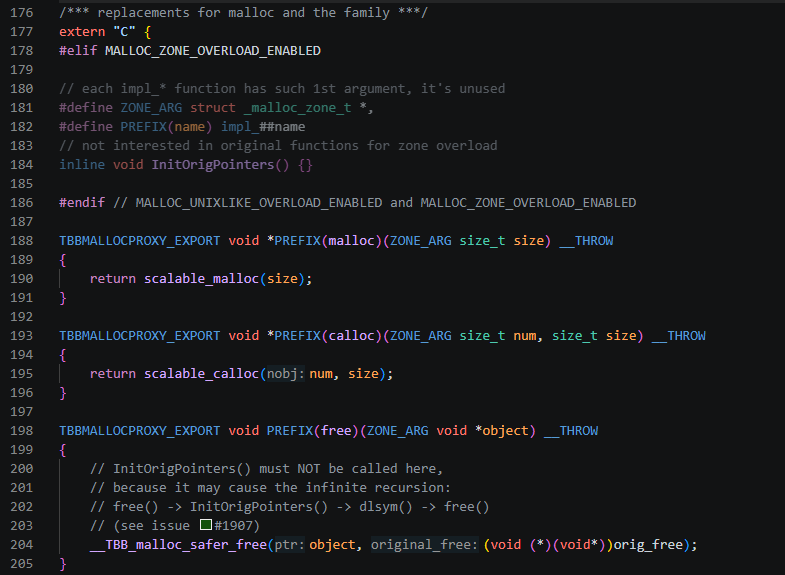
并调用dlsym(RTLD_NEXT, ...)保留系统原始的symbol,用作初始化阶段bootstrap调用:
inline void InitOrigPointers()
{
    // race is OK here, as different threads found same functions
    if (!origFuncSearched.load(std::memory_order_acquire)) {
        orig_free = dlsym(RTLD_NEXT, "free");
        orig_realloc = dlsym(RTLD_NEXT, "realloc");
        orig_msize = dlsym(RTLD_NEXT, "malloc_usable_size");
        orig_libc_free = dlsym(RTLD_NEXT, "__libc_free");
        orig_libc_realloc = dlsym(RTLD_NEXT, "__libc_realloc");

        origFuncSearched.store(true, std::memory_order_release);
    }
}
另外,使用__attribute__((alias))将libc库中的__libc_*等函数替换为对应的routines:
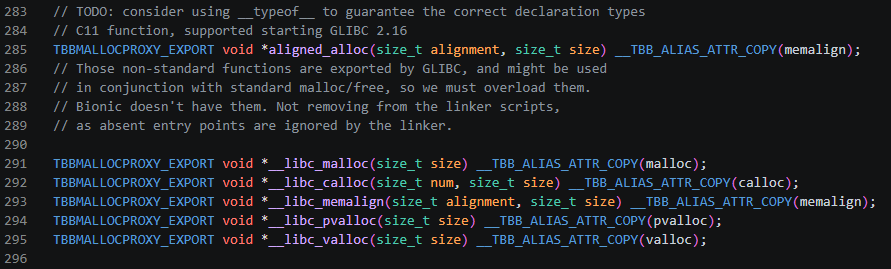
alias(“sym”) 让当前符号成为 sym 的别名,两个名字指向同一段代码。即将
__libc_free等符号截获并替换为free等符号。
A. 资料
- Memory Allocation:官方文档
- Scalable Memory Allocation for Parallel Algorithms
- scalable_allocators:Intel TBB scalable_malloc benchmark
- 2007-vol11-iss-4-intel-technology-journal:早期讲述TBB Malloc设计的文章(
Scalable Memory Allocator Architecture),介绍了当时的设计思路和实现细节。搜索allocator
Enjoy Reading This Article?
Here are some more articles you might like to read next: