CUDA入门:Bank Conflict
使用到的测试代码:bank_conflict.cu
1. Bank Conflicts (Shared Memory)
1.1. Bank 划分
针对Shared Memory的访问,CUDA使用bank机制,将shared memory的访问(读/写)映射到不同的bank,以实现并行访问。bank以4字节为单位,共32个bank。这样,一个时钟周期内,可以并行访问32个不同的bank,即访问128字节的数据。映射公式bank index = (address /4) % 32。
⭐ 每次发起共享内存事务(transation)时,可以从这 32 个 bank 中分别读取一个 32 位数据。以 32 位的字为单位索引,则 bank 以地址的低 5 位进行划分,与高位没有关系。
图示transaction:
Thread(在CUDA Core中)
    ↓
  访问Shared Memory
    ↓
[Bank系统处理] ← Transaction 在这里发生
    ↓
返回数据到Thread
举例:warp中定义的shared memory如何映射到banks:
__shared__ float s[64];
如上变量,其映射如下:

1.2. Bank Conflicts
在一次transaction的时候,如果,当warp中的不同线程访问到同一个bank中的不同地址时,就会产生Bank Conflicts,导致访问串行化:需要分成多次transaction。有N个线程访问同一个bank,称为N-way Bank Conflicts。
所谓
Bank Conflicts,只与transaction有关,即其由Shared Memory访问控制器相关。引用https://forums.developer.nvidia.com/t/how-to-understand-the-bank-conflict-of-shared-mem/260900/2: When you store (or load) more than 4 bytes per thread, which is like saying more than 128 bytes per warp, the GPU does not issue a single transaction. The largest transaction size is 128 bytes. If you request 16 bytes per thread, then warp wide that will be a total of 512 bytes per request (warp-wide). The GPU will break that up into 4 transactions (in that case: T0-T7 make up a transaction, T8-T15 are a transaction, and so on), each of which is 128 bytes wide. The determination of bank conflicts is made per transaction, not per request or per warp or per instruction.
如下情况,会产生Bank Conflicts:
- 一次
transaction中,warp中的多个线程,访问同一个bank中的不同地址; - 一次
transaction中,warp中的多个线程,访问shared memory的下一个128字节,被映射到同一个bank。此时也是属于上一种情况:同一个bank中的不同地址。
如下情况,Bank Conflicts不会产生:
-
warp中的线程,访问地址唯一对应到bank簇的每个bank,不论是顺序,还是错位; -
warp中的多个线程,访问同一个bank中的相同地址–使用boardcast分发相同地址数据到多个线程; -
warp中的线程,单个线程一次访问多个bank,但其他线程不访问这些bank。此时,生成多次transaction。
总结来说:一次内存事务(SMEM 读/写),传输大小为128字节,并对应到32个bank。如果SMEM中有两个不同地址落入到同一个bank,则产生bank conflict,导致访问串行化。另外一个概念是:bank conflict,是在warp级别上发生的(可以理解为:warp是一个最小的调度单元,其对SMEM的一次访问对应到一次内存事务)。
2. Bank Conflicts 示例
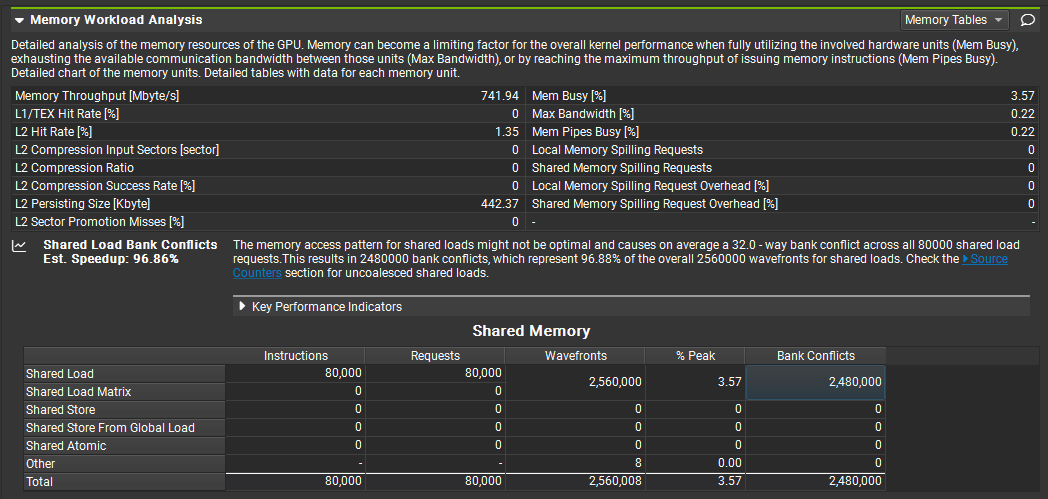
如下示例,产生32路Bank Conflicts:
const int num_iters = 10000;  // 全局常量

__global__ void all_conflicts() {
  __shared__ float s[32][32];
  [[maybe_unused]] int warp_id = threadIdx.y;
  int lane_id = threadIdx.x; // thread 在 warp 中的 id

  float *ptr = &s[lane_id][0];
  int addr = (int)(uintptr_t)ptr & 0xFFFF;
  [[maybe_unused]] float r1; // 声明输出变量

  for (int j = 0; j < num_iters; j++) { // num_iters 定义为 100'000
    asm volatile("ld.volatile.shared.f32 %0, [%1];" : "=f"(r1) : "r"(addr));
  }
}

// launched withall_conflicts<<<1, dim3(32, 8)>>>();
// Gride size: 1(即只有一个Block)
// Block size: dim3(32, 8)(即有8个warp,每个warp 32个线程)

由于是 32-way Bank Conflicts,则每个 warp 产生的 bank conflicts 次数是 10000 * 31,所有 warp 总共是 8 * 10000 * 31 = 2,480,000 次。与 Nsight Compute 测量结果吻合。
2.1. conflict free 代码参考
__global__ void conflict_free_kernel() {
  __shared__ float s[8][32];
  int warp_id = threadIdx.y;
  int lane_id = threadIdx.x;

  float *ptr = &s[warp_id][lane_id];
  int addr = (int)(uintptr_t)ptr & 0xFFFF;
  [[maybe_unused]] float r1;  // 声明输出变量

  for (int j = 0; j < num_iters; j++) {
    asm volatile("ld.volatile.shared.f32 %0, [%1];" : "=f"(r1) : "r"(addr));
  }
}

// conflict_free_kernel<<<1, dim3(32, 8)>>>();
// Gride size: 1(即只有一个Block)
// Block size: dim3(32, 8)(即有8个warp,每个warp 32个线程)
2.2. 矢量读写指令
使用矢量指令ld.shared.v4可以读取4个连续的32位数据。如下代码,一个线程读取s[4*i], s[4*i+1], s[4*i+2], s[4*i+3](分为四个transaction)。会产生四路Bank Conflicts:
__global__ void vectorized_loads() {
    __shared__ float sh[8][128];

    int warp_id = threadIdx.y;
    int lane_id = threadIdx.x;

    float4* ptr = reinterpret_cast<float4*>(&sh[warp_id][lane_id * 4]);
    int addr = (int)(std::uintptr_t)ptr & 0xFFFF;

    float4 r;
    for (int j = 0; j < num_iters; j++) {
        asm volatile ("ld.volatile.shared.v4.f32 {%0,%1,%2,%3}, [%4];"
                        : "=f"(r.x), "=f"(r.y), "=f"(r.z), "=f"(r.w)
                        : "r"(addr));
    }
}

// vectorized_loads<<<1, dim3(32, 8)>>>();

上图只给出了一半的线程访问情况。编号(
Lane)为0的线程与编号为8的线程,访问的shared memory中的数据映射到了同一个bank 0;同时,编号为16,以及24,同样映射到了bank 0。 不过,由于其每个线程一次访问 4 个 32 位数据,其平均访问时间折算下来,与 32 位加载相当。
要想避免Bank Conflicts,可以错开(interleave)冲突的线程访问的顺序,比如:
- 线程0:s[0] -> s[1] -> s[2] -> s[3]
- 线程8:s[33] -> s[34] -> s[35] -> s[32]
3. 避免 Bank Conflicts 的方法
3.1. Padding
warp内多个线程访问同一bank会引发冲突,导致串行化访问。 通过在二维共享内存数组的列数上 +1 padding,可打破映射冲突:从第二行开始,Shared Memory中的数据到bank的映射偏移一个bank,且每行累积。示意图:

示例代码:
__shared__ float sData[BLOCKSIZE][BLOCKSIZE + 1]; // +1 避免bank冲突

int x = threadIdx.x;
int y = threadIdx.y;
sData[x][y] = matrix[y * col + x];
__syncthreads();
matrixTest[y * col + x] = sData[x][y];
当warp中的线程步长间距为128字节(32个32位数据)时,适用于padding,例如:
| 场景 | 冲突原因 | Padding方案 |
|---|---|---|
| 列访问 | 行步长=32*4 | 列+1 |
| 步长访问 | 步长是32*k | 改变数组维度 |
| 结构体数组 | 字段偏移相同 | 结构体+padding |
| 斜向访问 | 特定步长产生周期 | 适当增加维度 |
3.2. Swizzle
Swizzle是通过重新排列线程访问顺序,来避免Bank Conflicts。假设有32×32的二维数组,原本按列访问产生冲突:
// 原始访问(产生冲突)
int x = threadIdx.x;
int y = threadIdx.y;
float val = s[x][y];  // 同列线程映射到同一bank
使用Swizzle变换:
// Swizzle:对线程索引进行XOR操作
int x = threadIdx.x;
int y = threadIdx.y;
int swizzled_x = x ^ (y % 32);  // 用XOR改变x坐标

float val = s[swizzled_x][y];  // 现在不同线程映射到不同bank
内存布局对比:
原始内存:
[0,0] [1,0] [2,0] ... [31,0]  <- 映射到bank 0,1,2...31
[0,1] [1,1] [2,1] ... [31,1]  <- 映射到bank 0,1,2...31(重复)
...

Swizzle后的访问顺序:
线程[0,0]访问 s[0^0][0] = s[0,0]
线程[1,0]访问 s[1^0][0] = s[1,0]
线程[2,0]访问 s[2^0][0] = s[2,0]
...
线程[0,1]访问 s[0^1][1] = s[1,1]  <- 同列不同线程,映射不同bank
线程[1,1]访问 s[1^1][1] = s[0,1]
...

内存物理位置不变,但访问顺序改变了
常见Swizzle操作:
// 方法1:XOR swizzle(最常用)
int swizzled = x ^ (y & (WARP_SIZE - 1));

// 方法2:位移swizzle
int swizzled = (x + y) % 32;

// 方法3:混合操作
int swizzled = (x + (y >> 4)) % 32;
Swizzle更多资料:
- CUTLASS CuTe GEMM细节分析(三)——Swizzle<B, M, S>模板参数的取值
- issue – how to understand “block swizzling”:Swizzle可以提升L2 cache命中率
- issue – Swizzling the shared memory
4. 概念总结
Lane ID:每个线程在warp中的编号,范围为0-31,物理固定。
sector:L1TEX / L2 缓存的最小传输单位是 sector,大小为 32 字节。一条缓存 cacheline = 128 字节 = 4 个 sector。一个 warp(32 线程)发出内存请求时,硬件会把所有线程的访问地址合并(coalesce),看需要覆盖几个 sector。
wavefront:在 L1TEX语境下,表征 L1TEX 处理一次内存请求,需花费的次数。举例如下:
情形一:4 sectors,1 wavefront(理想)
32 个线程访问连续的 128 字节(完全合并)
   → 覆盖 4 个 sector,但地址都在同一个 cacheline
   → 1 个 wavefront 处理完毕,消耗 1 个周期
情形二:4 sectors,2+ wavefronts(有冲突/分散)
32 个线程访问的地址跨越多个 cacheline 或
访问了 shared memory 中有 bank conflict 的位置
→ 同样是 4 个 sector 的数据量
→ 但 L1TEX 无法一次处理,需要拆成 2+ 个 wavefront
→ 消耗 2+ 个周期
内存事务(Memory Transaction):每次访问共享内存时,硬件会将访问请求打包成内存事务。一个 warp 内的多个线程可能会访问同一个 bank,从而产生 bank conflicts,导致内存事务被串行化。transaction 与 wavefront 应该是同一个意思。
Bank Conflicts相关名词:
当发生 bank conflict 时,warp 需要额外的一个 cycle 来重新提交 shared memory 的访问指令到 LSU 单元,该指令需要在 MIO 中排队,这种排队会导致访问延迟增加,此时 warp 可能处于等待数据返回的状态,warp state 标识为 Stall Short Scoreboard。
如果 MIO 队列满,此时 warp 先需要等待 MIO 队列处于非空的状态,此时 warp state 标识为 Stall MIO Throttle。
A. 学习资料
Enjoy Reading This Article?
Here are some more articles you might like to read next: